

EzJSON
EzJSON
Couldn't load pickup availability
The AD-DA.ca EzJSON plugin brings JSON processing capabilities to Q-SYS, enabling seamless encoding and decoding of JSON data structures.
JSON (JavaScript Object Notation), recognized as a standard for data interchange in modern applications, allows structured data exchange with web services, APIs, and third-party systems in a lightweight and human-readable format.
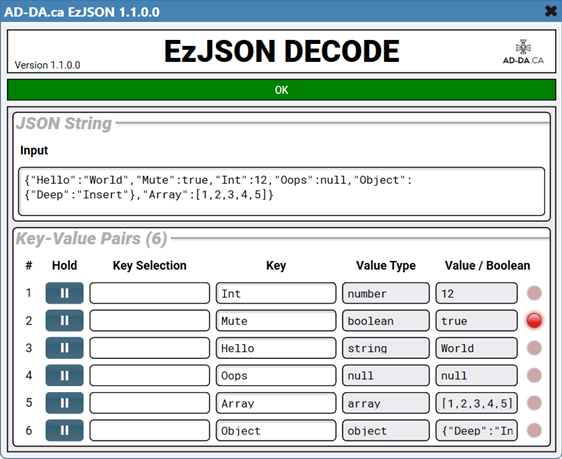
The plugin supports dual-mode operation. In Encode mode, key/value controls are transformed into a JSON string output. In Decode mode, an input JSON string is parsed and mapped back to key/value controls with automatic type detection.
Key features
-
Dual operation mode - switch between
EncodeandDecode -
Dynamic data pairs - configure from
1to64key/value rows per instance -
Multi-type support -
string,number,boolean,null,object,array -
Pretty JSON output - optional formatted JSON with indentation
-
Decode key selection - select parsed keys using per-row
Selectcontrols -
Per-row hold behavior - retain decoded values with
Holdtoggles -
Status diagnostics - detailed status and fault messaging
-
Debug print levels - console verbosity control via
Debug Printproperty
Use cases
-
Build JSON payloads for external REST APIs from Q-SYS controls
-
Parse incoming JSON-like text payloads into deterministic control rows
-
Bridge Q-SYS logic with cloud services and control orchestrators
-
Create layered/nested JSON using daisy-chained EzJSON instances
Configuration Overview
Plugin version
This document is written for the plugin :
-
AD-DA.ca EzJSON V1.1.0.0
Release note
[2026-06] : V1.1.0.0
-
Performance optimisation
-
New UI
[2025-08] : V1.0.1.0
-
Initial release to Asset Manager
[2025-08] : V1.0.0.0
-
Initial release of EzJSON plugin
-
Support for
String,Number,Boolean,Null,Object,Array -
Dual mode operation (
Encode/Decode) -
Support for up to
64key-value pairs -
Error handling and validation
Share